Thanasis Petras
International Correspondent
Chief Editor & Publisher — Diethni.gr
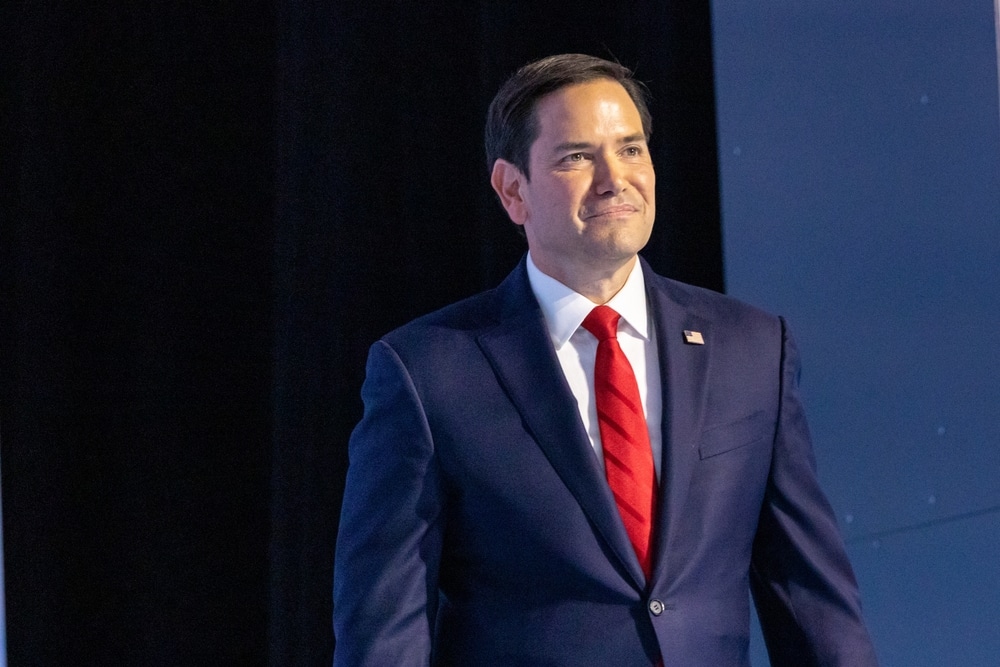
Marco Rubio is a gifted politician whose communication skills and knowledge of international affairs are complemented by an increasingly valuable political asset: the ability to address different social, educational and ideological audiences in a deeply divided America.
At 55, Rubio has developed a political identity combining elements that might initially appear difficult to reconcile. He represents traditional American conservatism, with extensive experience in Washington’s institutions and familiarity with the national-security establishment. At the same time, he has adapted to the political landscape created by Donald Trump, securing a prominent place in the administration and developing links with MAGA—Make America Great Again—the movement built around Trump that has become a dominant force within the Republican Party.
His distinctiveness lies in this balance. Rubio has cultivated a disciplined, policy-focused profile without identifying entirely with either traditional neoconservatives or the more isolationist currents of the American Right.
His background as the son of Cuban immigrants also gives him a personal connection to the American dream. Raised in a working-class family, he reached the leadership of American diplomacy while retaining his Catholic faith and commitment to traditional family values.
Together, his experience, personal story and communication skills could provide the foundations for a presidential campaign capable of reaching a broad constituency.
His speech at the historic Pnyx in Athens on 7 October 2026 offered an illustration of this political identity—and, potentially, an indication of how he might frame his own message for the post-Trump era.
The Pnyx and a speech with presidential overtones
The choice of the Pnyx, where the citizens’ assembly met in ancient Athens, gave the secretary of state’s address particular symbolic weight.
Rubio moved beyond a conventional diplomatic statement about Greek–American relations. He set out a broader political and ideological argument about the future of the West, national sovereignty, cultural identity and the United States’ role in a rapidly changing world.
Connecting ancient Greek heritage with modern Western political thought, he presented “America First” as an approach to reconciling national interests with international alliances, rather than a rejection of cooperation.
The speech had a clear diplomatic purpose. Its substance and symbolism also suggested something more ambitious: a political leader seeking to define principles that could shape American foreign policy for years to come.
Viewed in that context, the Pnyx could acquire particular significance in Rubio’s political career. He did not announce a presidential candidacy. He did, however, present a coherent vision that could contribute to a future bid for the White House.
The first since Henry Kissinger
Rubio’s political assets extend beyond his communication skills. He has also occupied an unusually powerful institutional position.
In May 2025, Trump assigned him the additional responsibilities of acting national security adviser, making him the first official since Henry Kissinger to hold that role alongside the office of secretary of state.
The historical comparison is striking. Kissinger held both positions from 1973, during a period shaped by relations with the Soviet Union, the opening to China and major Cold War realignments.
More than half a century later, Rubio has found himself at the centre of another complex strategic environment: competition with Beijing, relations with Moscow, the Middle East and the future of the transatlantic alliance.
Holding both responsibilities does not place him on the same historical footing as Kissinger. It does demonstrate his institutional importance and the trust Trump has placed in him.
That trust carries considerable political weight in an administration where personal access to the president is a decisive source of influence.
A bridge to Washington’s national-security establishment
Rubio’s position becomes more interesting when considered alongside his relationship with the institutions through which American power is exercised.
During his long Senate career, he served on the Intelligence and Foreign Relations committees, developing a substantial understanding of intelligence agencies, the Pentagon and the wider national-security system.
He also understands the importance of America’s defence-industrial base to the country’s strategic, economic and technological strength.
This institutional familiarity distinguishes him from politicians whose rise has depended more heavily on MAGA’s anti-establishment rhetoric.
Rubio understands institutions that Trump has sometimes regarded with suspicion. Yet he has become a central presidential partner without allowing that background to prevent his integration into the administration.
His position also matters to foreign leaders. In a government where diplomacy is heavily influenced by Trump’s personal interventions and often unpredictable negotiating tactics, Rubio provides an important channel to Washington.
For some overseas counterparts, he may represent the administration’s more institutional and policy-focused dimension—a measure of continuity amid rapid political change.
In that sense, he can be seen as a potential “voice of reason”: an official with the experience to explain and implement the president’s decisions through the language of established diplomacy. That does not necessarily imply disagreement with Trump.
The combination of institutional knowledge and access to the president may be among Rubio’s strongest political assets.
MAGA and a potential contest with JD Vance
Discussion of Rubio’s future inevitably leads to the question of Trump’s succession and a possible contest with Vice President JD Vance.
The two men represent different paths within American conservatism.
Vance emerged through the newer generation of national conservatism and maintains strong ties to MAGA’s core. His political identity is closely associated with economic nationalism, industrial renewal and a challenge to established political elites.
Rubio combines the Trump administration’s agenda with the experience of the traditional Republican Party and a detailed understanding of American institutions.
The distinction is reflected, to some extent, in the polling cited in this analysis.
At CPAC’s March 2026 straw poll, Vance received 53 per cent to Rubio’s 35 per cent, demonstrating his strength among participants at the conservative gathering.
A May survey by Overton Insights, however, put Rubio at 32 per cent and Vance at 39 per cent in a hypothetical Republican primary featuring several candidates.
The same survey’s direct comparison produced a different result: Rubio received 42 per cent to Vance’s 36 per cent, with 22 per cent undecided.
An August survey in Texas showed the two almost level, at 29.5 per cent for Rubio and 28.8 per cent for Vance.
These results come from different samples and cannot establish a consistent national trend. They nevertheless suggest that Rubio deserves serious attention in discussions about the Republican Party’s future.
If both men seek the presidential nomination in 2028, their contest could become a debate about the ideological direction of American conservatism.
The question would extend beyond who succeeds Trump. It would concern how his political legacy is carried forward: through a more confrontational, anti-establishment expression of MAGA, or through a more institutional incorporation of its central principles into government.
The American dream and the possibility of reaching beyond division
Rubio’s personal background gives him another potential advantage in a diverse society.
His journey from a Cuban immigrant family in Miami to the leadership of the State Department fits naturally within the narrative of the American dream.
His Latin American heritage, Catholic faith and emphasis on family values give him points of connection with different social and religious communities.
Those connections do not guarantee their support. They do provide a personal story that reaches beyond the familiar image of Washington’s political establishment.
This matters in a country experiencing deep polarisation, public distrust and episodes of political violence.
Could a politician with Rubio’s communication skills, institutional experience and personal background help rebuild a broader sense of national understanding?
The answer remains open. He is a central figure in an administration that generates intense political controversy, and he has not demonstrated broad bipartisan acceptance.
Nevertheless, his ability to move between different political and social settings could become significant in a future national campaign.
Meanwhile, the Democratic Party has yet to produce an uncontested leading figure for the 2028 presidential election, leaving the eventual political landscape highly uncertain.
From the Pnyx to the Oval Office?
Rubio’s Athens address becomes more revealing when placed within the wider trajectory of his career.
He appeared as more than the chief diplomat of a superpower. He sought to articulate a political message connecting Western cultural heritage, national sovereignty, traditional values and American strategic strength.
His substantial institutional responsibilities, Trump’s trust, familiarity with the national-security system and growing presence in discussions about the Republican nomination create an important foundation for a possible leadership bid.
The central question is whether he can turn that combination into a message capable of connecting traditional Republican voters with MAGA—and potentially reaching beyond the party’s boundaries.
A contest with Vance would be an important arena in which the post-Trump identity of the Republican Party could take shape.
At the Pnyx, Rubio did not declare himself a presidential candidate. His address nonetheless had the structure and symbolism of a broader political intervention whose significance could grow in the years ahead.
Perhaps the most important question is whether Rubio can embody the transition from Trump’s presidency to a new phase of American conservatism, rather than simply whether he becomes the 48th president.
If he does, his speech at the Pnyx may eventually be remembered as more than a diplomatic occasion: it could become an early landmark on his path towards the Oval Office.